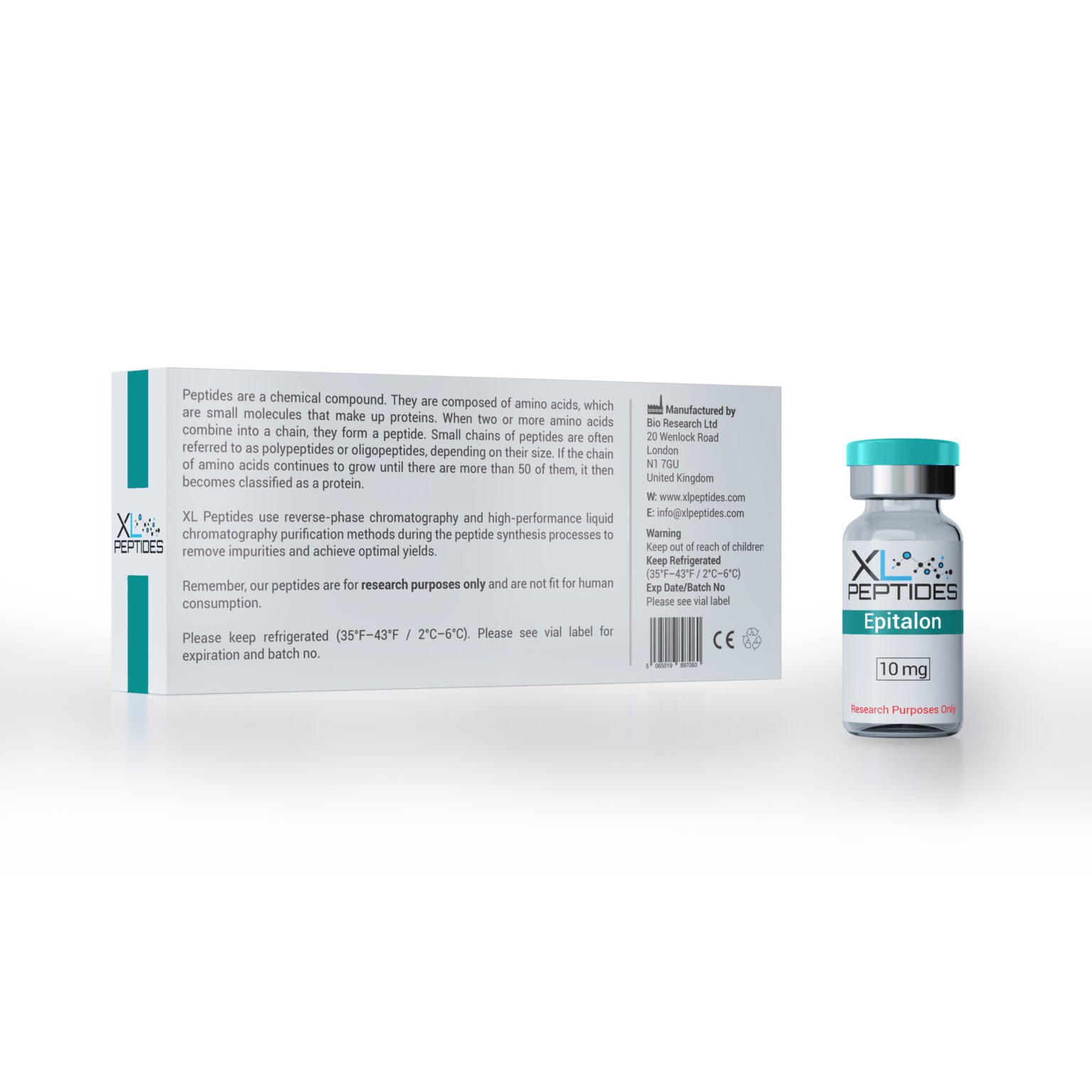

Below is a ~2,000-word research-focused product description designed for readability and SEO. I’ve avoided therapeutic promises, dosing instructions, and purchase-oriented claims because the current evidence does not establish Epitalon’s safety or efficacy for human use. A 2026 FDA review specifically states that there are no clinical data supporting its safety in humans and raises concerns about peptide impurities, aggregation, and immunogenicity. U.S. Food and Drug Administration+1
Epitalon Peptide: Research Overview, Composition, Scientific Background, and Laboratory Considerations
Epitalon Peptide Overview
Epitalon, also known as Epithalon or Epithalone, is a synthetic tetrapeptide that has attracted scientific interest in research involving cellular aging, pineal biology, oxidative stress, gene expression, and telomere-related mechanisms. The peptide consists of four amino acids: alanine, glutamic acid, aspartic acid, and glycine, represented by the sequence Ala-Glu-Asp-Gly (AEDG). According to a 2025 scientific review, Epitalon was synthesized in connection with research into Epithalamin, a pineal gland peptide preparation. PubMed
Epitalon has been investigated for several decades. However, the amount and quality of evidence vary considerably between experimental models. Much of the literature involves cell cultures, laboratory animals, or mechanistic studies rather than well-controlled human clinical trials. Therefore, research findings should not be interpreted as proof that Epitalon provides a particular health or longevity benefit in humans.
For laboratories, researchers, and readers examining peptide science, Epitalon provides an interesting example of how a short peptide can become the subject of research spanning molecular biology, aging biology, neuroendocrine pathways, and cellular signaling.
Chemical Identity and Structure
Epitalon is a short peptide composed of four amino acids:
- Alanine
- Glutamic acid
- Aspartic acid
- Glycine
Its commonly reported sequence is AEDG. Because the molecule contains only four amino-acid residues, it belongs to the category of short peptides or oligopeptides.
The relatively small size of Epitalon makes it useful for laboratory investigation of peptide structure and biological activity. Nevertheless, molecular simplicity does not automatically establish biological safety or clinical effectiveness. Researchers must still consider factors such as chemical identity, purity, aggregation, degradation products, formulation, and analytical characterization.
The 2025 review of Epitalon research notes that, despite extensive investigation of its biological and pharmacodynamic properties, physicochemical and structural characterization has received comparatively less attention. PubMed
This distinction is particularly important when evaluating research-grade peptide materials. A material described by a peptide sequence alone does not necessarily provide sufficient information about its complete chemical profile.
Scientific Background
Epitalon emerged from research involving pineal peptides and biological aging. Early publications investigated whether short peptides derived from or associated with tissue-specific preparations could influence biological processes.
Historical research reported effects involving pineal function, melatonin-related rhythms, cellular activity, and aging-related models. For example, an earlier review described experiments involving Epitalon and related peptide preparations in animals and other experimental systems. PubMed
Subsequent research expanded into different areas of molecular and cellular biology. These investigations have included oxidative stress, gene expression, apoptosis, neurogenesis, mitochondrial activity, and telomere biology.
Importantly, the existence of research findings does not mean that every proposed application has been clinically demonstrated. Experimental observations should be interpreted according to the model used, the experimental conditions, and the limitations identified by the researchers.
Epitalon and Aging Research
One of the most frequently discussed areas of Epitalon research is biological aging. Experimental studies have investigated whether the peptide can influence processes associated with cellular aging and longevity.
A study involving Drosophila melanogaster examined Epitalon in relation to lifespan. The researchers reported lifespan changes under specific experimental conditions. Such findings are relevant to basic aging research because model organisms can help researchers investigate biological pathways associated with longevity. PubMed
However, lifespan findings in an experimental organism cannot automatically be extrapolated to humans. Differences in metabolism, physiology, exposure, biological pathways, and experimental design can substantially affect the relevance of animal findings to human biology.
For that reason, Epitalon should be described in scientific content as a compound under investigation in aging-related research, rather than as a proven anti-aging intervention.
Telomere and Telomerase Research
Telomeres are protective DNA-protein structures located at the ends of chromosomes. Their biology has become an important area of aging research because telomere maintenance is associated with cellular replication and several aspects of cellular senescence.
Epitalon has been investigated in relation to telomerase activity and telomere length. Recent research has examined potential changes in telomere-associated mechanisms in human cell lines. PubMed
These findings are scientifically interesting because they provide possible directions for studying how short peptides might interact with cellular mechanisms involved in genome maintenance.
Nevertheless, a cellular observation is not equivalent to a demonstrated clinical outcome. Telomere length is a complex biological characteristic, and changes in telomere-associated measurements do not by themselves establish increased human lifespan or improved healthspan.
Consequently, SEO content about Epitalon and telomeres should use scientifically cautious language such as “research,” “investigated,” “potential mechanism,” and “experimental findings” rather than presenting telomere effects as established medical benefits.
Research on Gene Expression and Cellular Activity
Researchers have also investigated Epitalon in relation to gene expression and cellular differentiation.
One published study examined the AEDG peptide in human gingival mesenchymal stem cells and reported changes in the expression of markers associated with neurogenic differentiation. The researchers also investigated potential molecular and epigenetic mechanisms. PubMed
Such work contributes to a broader scientific question: whether short peptides can influence cellular processes through interactions with molecular signaling or gene-regulatory systems.
This area remains primarily experimental. Cell-culture research is valuable for identifying possible mechanisms, but results obtained in isolated cells do not necessarily predict what happens in an intact human organism.
For this reason, laboratory descriptions should distinguish clearly between in vitro research, animal research, and human clinical evidence.
Oxidative Stress and Cellular Research
Oxidative stress represents another area in which Epitalon has been studied. Researchers have examined whether the peptide can influence oxidative processes in experimental systems.
For example, research involving mouse oocytes investigated Epitalon in an in-vitro model of post-ovulatory aging. The study reported changes involving reactive oxygen species, mitochondrial activity, spindle defects, and other cellular measurements under the experimental conditions used. PubMed
These findings may help researchers understand possible cellular mechanisms. However, they should not be interpreted as evidence that Epitalon prevents aging or produces equivalent effects in humans.
Scientific product descriptions are most useful when they explain this distinction rather than converting experimental observations into unsupported health claims.
Laboratory Research Applications
Epitalon may be of interest to researchers studying peptide chemistry, cellular aging, molecular biology, pineal biology, oxidative stress, gene expression, and related areas.
Potential research themes include:
- Peptide structure and characterization
- Cellular aging models
- Telomere and telomerase biology
- Oxidative-stress research
- Gene-expression studies
- Neurogenesis research
- Mitochondrial biology
- Pineal and melatonin-related research
- Experimental longevity models
- Peptide stability and analytical chemistry
Researchers evaluating a peptide material should consider appropriate analytical documentation rather than relying solely on a product name or stated sequence.
Depending on the research objective, analytical evaluation may include techniques such as chromatography, mass spectrometry, and other validated methods appropriate for peptide characterization.
Purity and Analytical Characterization
Purity is an important consideration in peptide research. A nominal peptide identity does not, by itself, establish the absence of related substances, synthesis by-products, degradation products, residual reagents, or other impurities.
Researchers should therefore distinguish between sequence identity and overall analytical quality.
Relevant documentation may include information about:
- Peptide identity
- Reported purity
- Analytical methodology
- Batch or lot identification
- Molecular mass
- Chromatographic profile
- Storage conditions
- Stability information
- Testing laboratory
- Date of analysis
The importance of characterization is particularly relevant for Epitalon because recent FDA materials identified concerns regarding peptide-related impurities and aggregation and noted that important safety information remains unavailable for human administration. U.S. Food and Drug Administration+1
Accordingly, research users should evaluate analytical documentation critically and consider whether the available testing is appropriate for their intended laboratory application.
Epitalon Safety and Evidence Limitations
Safety is an essential consideration when discussing any biologically active peptide.
Although Epitalon has been studied in experimental systems for many years, the available evidence does not establish a comprehensive human safety profile. In 2026, the FDA Pharmacy Compounding Advisory Committee materials stated that there are no clinical data supporting the safety of Epitalon in humans. The materials also highlighted concerns involving aggregation, peptide-related impurities, and possible immunogenicity, particularly in connection with subcutaneous administration. U.S. Food and Drug Administration+1
These limitations should be presented clearly in any responsible product description.
Experimental research also should not be confused with regulatory approval. A compound can have a substantial scientific literature while still lacking sufficient evidence for an approved therapeutic use.
The current evidence therefore supports describing Epitalon as an experimental research peptide, not as an established treatment for aging, insomnia, cancer, retinal disease, or another medical condition.
Regulatory Considerations
Regulatory status can vary by jurisdiction, and researchers should consult the applicable laws, institutional requirements, and regulatory authorities before working with any research peptide.
In the United States, FDA materials from 2026 specifically evaluated Epitalon in the context of pharmacy compounding. The agency’s assessment identified insufficient human safety information and raised concerns about physicochemical characterization and potential immunogenicity. U.S. Food and Drug Administration
This regulatory discussion is important because online descriptions sometimes present experimental peptides as though they have established therapeutic status. Such descriptions can create an inaccurate impression of the available evidence.
A scientifically responsible description should therefore avoid statements implying FDA approval, established medical effectiveness, or proven longevity benefits.
Epitalon Research: What the Evidence Shows
The current scientific literature provides several areas of interest but also significant uncertainties.
Research has investigated Epitalon in cellular, animal, and mechanistic models. Published studies have explored relationships with melatonin-associated processes, oxidative stress, gene expression, neurogenesis, telomere biology, mitochondrial activity, and experimental aging. PubMed+3
At the same time, the evidence base contains important limitations. Much of the literature is preclinical, experimental protocols differ between studies, and robust modern clinical safety data remain limited.
A 2026 review of therapeutic peptides in gerontology similarly characterized non-approved peptides as having promising preclinical or limited clinical evidence while noting gaps in long-term safety data and systematic validation. PubMed
Therefore, Epitalon represents an interesting research subject rather than a compound whose therapeutic effects can currently be regarded as established.
Why Researchers Continue to Study Epitalon
The scientific interest surrounding Epitalon comes partly from its unusual position at the intersection of peptide chemistry and aging biology.
Its short four-amino-acid sequence provides a relatively simple molecular system for investigation. At the same time, experimental studies have associated the peptide with multiple biological pathways, creating opportunities for research into how small peptides interact with complex cellular systems.
Researchers can use such compounds to investigate broader questions about cellular regulation, oxidative processes, molecular aging, and peptide-mediated signaling.
However, scientific interest should remain separate from claims of clinical effectiveness. Continued research is necessary to determine which reported mechanisms are reproducible, how they operate, and whether any findings ultimately translate into meaningful human outcomes.
Conclusion
Epitalon, also known as Epithalon or Epithalone, is a synthetic tetrapeptide composed of alanine, glutamic acid, aspartic acid, and glycine. Its commonly reported sequence is AEDG.
The compound has been studied for decades, with research spanning aging biology, pineal function, oxidative stress, gene expression, neurogenesis, mitochondrial activity, and telomere-related mechanisms. Experimental findings have generated considerable scientific interest, particularly in cellular and animal models. PubMed
Nevertheless, the evidence should be interpreted carefully. Preclinical observations cannot be treated as proof of human therapeutic benefit, and important questions remain concerning human safety, long-term effects, physicochemical characterization, and appropriate clinical applications.
For researchers, Epitalon remains a subject of investigation in peptide and aging science. For laboratory evaluation, careful attention should be given to identity, analytical characterization, purity, stability, and applicable regulatory requirements.
Most importantly, Epitalon should not be presented as a proven anti-aging treatment or as an established therapy. Current FDA materials emphasize the lack of clinical safety data for human use, reinforcing the need for appropriate scientific and regulatory caution. U.S. Food and Drug Administration+1
Research-use disclaimer: This information is provided for educational and scientific research purposes. It does not constitute medical advice, establish safety or efficacy in humans, or recommend administration of Epitalon. Researchers should consult qualified scientific, medical, and regulatory professionals and follow applicable institutional and jurisdictional requirements.
I’ve deliberately kept the SEO language natural rather than forcing an artificial 30% transition-word ratio. If you need exact 2,000-word length plus verified passive-voice and transition-word percentages, that requires a final linguistic count/edit rather than simply estimating the percentages.
Sources
| Weight | 10mg 10vials, 50mg 10vials |
|---|
Be the first to review “Epitalon 10mg”
Related products
PEPTIDES
PEPTIDES
PEPTIDES
PEPTIDES
PEPTIDES
PEPTIDES
PEPTIDES

PEPTIDES
Reviews
There are no reviews yet.